
Why Every Wheelchair-Accessible Vehicle Needs an Emergency Web Cutter
When Buckles Fail, Passengers Can’t Wait
A post-collision evacuation is one of the most stressful situations a transit driver or school bus aide will ever face. There may be smoke, fire, water, or structural damage. Passengers without disabilities can unbuckle and exit on their own. A wheelchair user cannot — they depend entirely on the person removing the tie-down straps to get them out.
Under normal operating conditions, a retractable tie-down releases cleanly with one hand. Under impact loads, that same retractor may have deformed enough to jam. A buckle that was perfectly functional before the collision may now require two hands, leverage, and more time than the situation allows. In those moments, an emergency web cutter is not an optional accessory — it is the contingency plan.
The Sure-Lok 8705: School Bus Standard
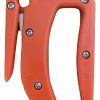
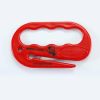
The Sure-Lok 8705 is a dedicated emergency web cutter designed for wheelchair securement applications. Its blade is recessed in a housing that allows a driver to cut through a loaded tie-down strap or securement loop webbing without risk of cutting the occupant. The ergonomic grip provides purchase under stress, and the bright-orange housing makes the tool easy to locate visually in low-light or smoky conditions.
The Sure-Lok 8705 specifically meets the requirements of the National Standards for School Buses, which address emergency egress equipment for vehicles transporting students who use wheelchairs. For school districts and school bus contractors, specifying the 8705 provides documented compliance with those standards. This is one of the clearest cases where the right product choice is also the documented compliance choice.
The Q’Straint Q5-7590
The Q’Straint Q5-7590 is Q’Straint’s emergency cutter, designed to work within the Q’Straint tie-down ecosystem. Like the Sure-Lok 8705, it features a protected blade and a grip profile suited to single-hand operation under stress. Fleets that run Q’Straint tie-down systems throughout their vehicles will typically specify the Q5-7590 to keep their emergency equipment from the same manufacturer as their securement system — simplifying procurement, training, and parts management.
Evacuation Scenarios Where Seconds Matter
Post-Collision Jam
The most common scenario where a cutter is needed: the vehicle has been in a rear-end or frontal collision, and one or more retractors have locked up under the impact load. The retractor will not release via the normal mechanism. The wheelchair user needs to exit the vehicle immediately. A web cutter resolves this in one motion. Without one, the driver is trying to work the retractor by hand while managing the rest of the evacuation.
Fire or Smoke Evacuation
When there is smoke in the vehicle, fine motor skill degrades quickly. A driver trying to work a buckle mechanism while coughing in smoke will take significantly longer than under normal conditions. A cutter that can be grabbed and used in a single gross-motor motion — even with impaired dexterity — is a meaningful advantage. The bright orange housing also aids location when visibility is reduced.
Water Submersion
Flooding events (flash floods, bridge incidents, extreme weather) can trap a vehicle rapidly. Water pressure against a door makes normal exit difficult, and once a vehicle is submerged, occupant restraints must be cut before the occupant can be moved. In school bus incidents near water, the ability to cut tie-downs quickly can be the difference between a successful rescue and a fatality.
Mounting Location Best Practices
A web cutter that can’t be found in an emergency provides no value. Mounting location and training are as important as the tool itself.
Mount It Where the Driver Can Reach It Without Unbuckling
The driver’s seat area — on the dash, console, or driver-side B-pillar — is the standard location. The driver should be able to locate and retrieve the cutter without leaving the driver’s seat area. In a post-collision event where the vehicle may have shifted or tipped, “easy reach from the driver’s position” is the practical standard.
Use a Proper Bracket or Holder
Both Sure-Lok and Q’Straint offer mounting brackets for their respective cutters. Use them. A cutter stored loose in a door pocket or glove box can be thrown to the back of the vehicle in a collision — exactly when you need it most. A mounted cutter stays in place through an impact event.
Secondary Location for Aide-Equipped Vehicles
On vehicles where a driver’s aide or attendant typically manages wheelchair securement, consider a second cutter mounted at the wheelchair securement position. If the driver is incapacitated in a collision, the aide needs a cutter at their working location — they can’t climb to the driver’s area to retrieve one. Two cutters per vehicle is not overkill for high-occupancy paratransit runs.