How to Choose the Right Wheelchair Securement Loop
Why Loop Selection Actually Matters
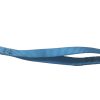
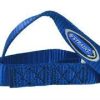
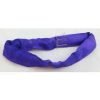
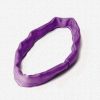
A wheelchair securement loop looks simple: a folded piece of webbing with a hardware attachment at the free end. But the wrong loop for the application can mean a strap that won’t reach its anchor, a connection that works loose during transit, or hardware that doesn’t fit the tie-down system your fleet already uses. Getting the selection right the first time saves money on returns, prevents field improvisation, and — most importantly — keeps wheelchair users safe.
Here’s how to work through the decision systematically.
Step 1: Determine the Required Length
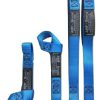
Securement loops are typically available in four standard lengths: 9 inches, 11 inches, 14 inches, and 18 inches. The right length depends on the geometry of the wheelchair frame and where the tie-down strap needs to connect.
9-Inch Loops
The shortest loops are designed for wheelchairs with compact or low-clearance frame tubes where a longer loop would create excess slack or interfere with the wheelchair’s structure. They’re also common on power wheelchairs where the attachment geometry is tight. Because there’s less webbing to manage, 9-inch loops are preferred when tidiness and a low-profile installation matter.
11-Inch Loops
The 11-inch length is the most versatile and the highest-volume size for most transit fleets. It fits the majority of manual and power wheelchair frames without creating excessive slack, and it gives enough reach to work around frame obstacles like batteries, footrest hardware, or armrest supports. If you’re stocking one size for a mixed fleet, this is usually the right call.
14-Inch Loops
Fourteen-inch loops are appropriate for large-frame power wheelchairs and scooters where the tie-down attachment point is farther from the frame tube, or where the loop needs to route around a large component. They’re also used in bariatric applications where the wheelchair frame geometry is larger overall.
18-Inch Loops
The longest standard loops are specialty items for very large power wheelchair frames or custom chair configurations where standard lengths simply won’t reach. If you’re encountering vehicles or chairs that require 18-inch loops, it’s worth a conversation with your tie-down system manufacturer to confirm the attachment geometry is appropriate.
Step 2: Evaluate Webbing Construction
Securement loop webbing in this category is typically rated to a minimum tensile strength of 6,000 pounds. That’s the threshold that allows the loop to function within a WC18-compliant tie-down system. Below that rating, a loop is not suitable for vehicle securement, regardless of how it looks.
Beyond tensile rating, look at:
- Webbing width — Wider webbing distributes load over a larger area of the wheelchair frame tube, reducing the risk of damage to the chair and improving load transfer geometry.
- Stitching pattern — Bar-tack or box-stitch patterns at the fold and hardware attachment points are signs of quality construction. Count the rows and compare between brands if you’re evaluating options.
- Edge treatment — Heat-sealed or bound edges resist fraying and extend service life, particularly in high-use fleet environments where loops are attached and removed multiple times per day.
Step 3: Match the Attachment Hardware
The hardware at the free end of the loop — typically a hook, ring, or clip — must be compatible with your tie-down strap’s tensioner. The major tie-down systems from Q’Straint and Sure-Lok use different hook geometries, and using mismatched hardware creates both a functional problem (won’t engage cleanly) and a safety problem (may not retain under load).
Single-Loop Configurations
A standard single loop attaches at one point on the wheelchair frame and provides the connection point for one strap. This is the most common configuration and works well for wheelchairs with defined, accessible tie-down attachment points.
Tethering Strap Configurations
Some securement loop assemblies include an integrated tethering strap — a short, fixed-length webbing section that creates a more rigid connection between the loop and the vehicle floor anchor. Tethering strap configurations are common in applications where the floor anchor geometry makes a direct strap-to-loop connection difficult to route cleanly.
Quick-Release Configurations
Quick-release loops incorporate a one-hand-operable release mechanism that allows rapid disconnection during emergencies or when the boarding and alighting process needs to be faster. These are particularly valued in paratransit and NEMT operations where driver assist time per passenger affects schedule adherence.
Step 4: Consider Color Coding for Fleet Operations
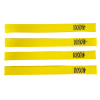
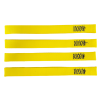
In fleet environments where multiple drivers and multiple shifts share equipment, color-coded loops reduce errors. A common convention uses different colors to indicate loop length: for example, a fleet might standardize on one color for 11-inch loops and a different color for 14-inch loops. When a driver reaches for the wrong size, the color mismatch is an immediate visual cue.
AMF Bruns, Q’Straint, and Sure-Lok all offer products in multiple colors. If your fleet is building a color-coding system from scratch, we recommend establishing the convention in your securement SOP before ordering, so you don’t end up with a mixed inventory that undermines the system.
Decision Flowchart: Which Loop Do You Need?
Work through these questions in order:
- What is the wheelchair type? Manual compact → start with 9″ or 11″. Manual standard or power → start with 11″. Large power chair or bariatric → start with 14″.
- Does the chair have designated tie-down attachment points? If yes, measure clearance from the frame tube. If the standard length loop reaches cleanly without bunching, proceed. If not, go up one size.
- What tie-down system is on your vehicles? Q’Straint tie-downs → use Q’Straint loops (Q5-7581 and related). Sure-Lok tie-downs → use Sure-Lok loops (FE200750 and related). Mixed or legacy fleet → verify hook compatibility before ordering.
- Is rapid release a priority? If yes, specify quick-release configuration. If the application is primarily paratransit or NEMT, quick-release is worth the modest cost premium.
- Is color coding in use? If yes, confirm the color-to-length convention before specifying the order.
Specific Product Notes
AMF Bruns H350258 — A workhorse loop from one of Europe’s longest-established wheelchair securement manufacturers. AMF Bruns products are widely used in European paratransit and are increasingly specified by North American fleets that want a European engineering pedigree alongside North American distribution.
Q’Straint Q5-7581 — Designed to work within the Q’Straint tie-down ecosystem. If your vehicles run Q’Straint floor anchors and retractors, the Q5-7581 series is the straightforward system-matched choice. Q’Straint is one of the most widely installed tie-down systems in North American paratransit.
Sure-Lok FE200750 — Sure-Lok’s securement loops are engineered for compatibility with Sure-Lok’s own tie-down hardware, which is prevalent in school bus applications. If your fleet includes school buses or you’re procuring across a mixed school-bus and paratransit fleet, Sure-Lok’s ecosystem compatibility is worth factoring in.
Questions? We’re Here.
Questions about choosing the right wheelchair securement loop? Call our team at 800-884-6456 or shop our full securement loop catalog.
Trusted brands we carry: AMF Bruns · Q’Straint · Sure-Lok